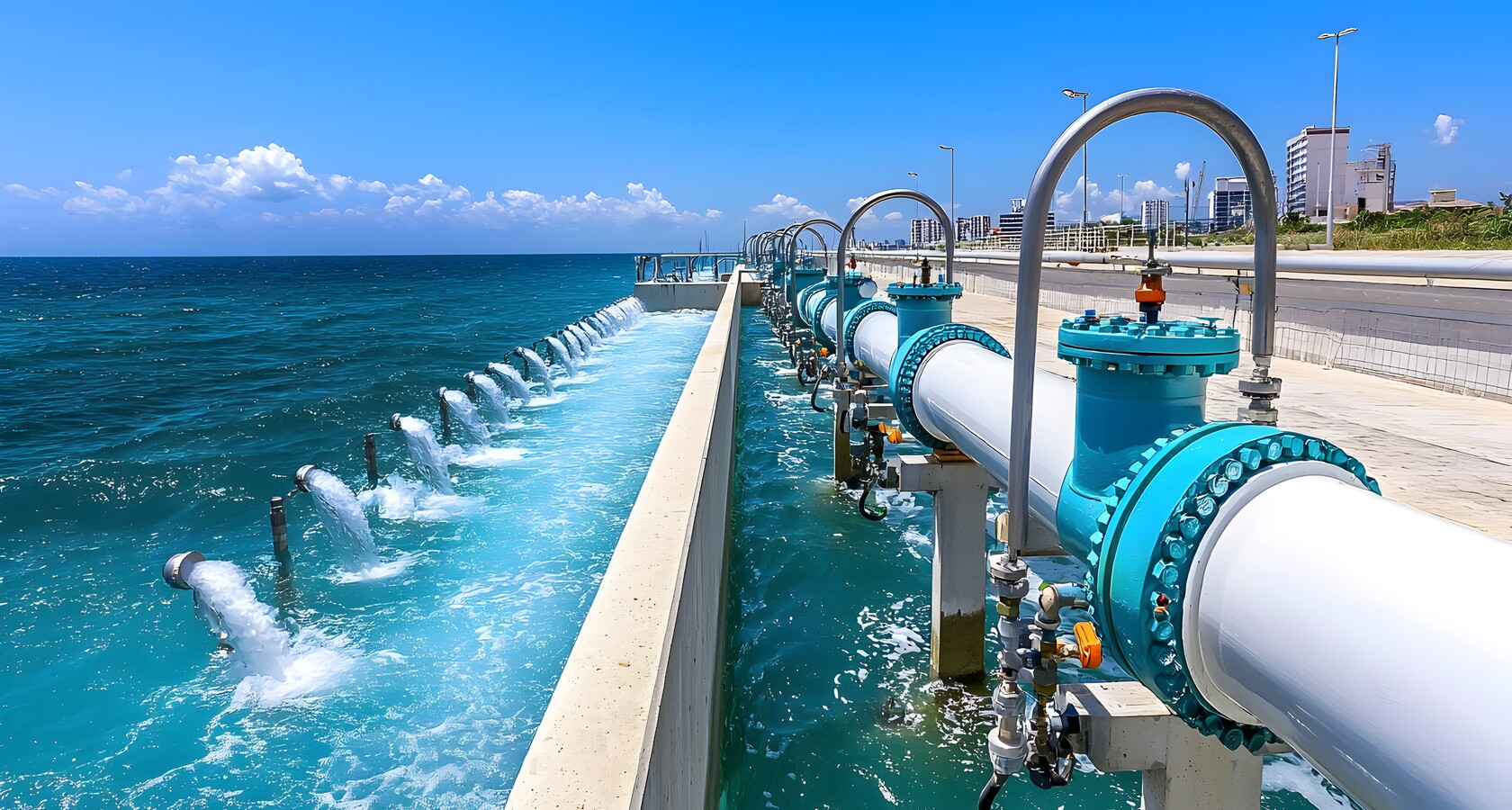
The new frontier of water
Rising water demand and climate change are pushing desalination to the forefront of national strategies: an increasingly efficient technology that integrates water security, energy, and infrastructure resilience
Water scarcity is rapidly emerging as one of the defining resource challenges of the twenty-first century. Population growth, urbanization, economic development, and climate change are placing unprecedented pressure on freshwater resources. In many regions, traditional water supplies—rivers, lakes, reservoirs, and groundwater aquifers—are becoming increasingly vulnerable to prolonged droughts, shifting precipitation patterns, and overexploitation.
For countries located in arid and semi-arid regions, the challenge is particularly acute. The question is no longer simply how to manage water resources more efficiently, but how to secure reliable water supplies in an increasingly uncertain climate. In response, seawater desalination has evolved from a niche technology into a strategic component of national water security.
The transformation is perhaps most visible in Israel and the Gulf region. Israel now obtains approximately 70–80 percent of its domestic drinking water from large seawater desalination plants, making the country largely independent of rainfall variability. Similarly, countries such as Saudi Arabia, the United Arab Emirates, and Kuwait rely on desalination for the majority of their municipal water supply. For these countries, desalination is no longer a response to water scarcity—it is the foundation of water security.
The growth of desalination has also been driven by economics. Governments increasingly invest in very large seawater desalination facilities capable of producing hundreds of thousands of cubic meters of freshwater per day. Like power plants, these facilities benefit from economies of scale. Larger plants reduce capital and operating costs per unit of water produced, making desalination increasingly competitive as a reliable source of municipal supply.
The key enabler behind this expansion has been a technological revolution. Early desalination facilities relied primarily on thermal processes that evaporated seawater and condensed the resulting vapor. While effective, these systems required large amounts of energy and were practical mainly in regions with abundant low-cost fossil fuels.
The transition to reverse osmosis fundamentally changed the industry. Instead of evaporating water, reverse osmosis uses pressure to force water molecules through semi-permeable membranes while rejecting dissolved salts. This innovation dramatically reduced energy requirements and transformed desalination from an expensive specialty technology into a scalable solution for water supply.
Today, desalination sits at the heart of the water-energy-food security nexus. Producing freshwater requires vast amounts of energy, while reliable water supplies are essential for energy production, industrial development, and food security. Understanding this relationship is critical for evaluating the future role of desalination in a water-stressed world.
The energy factor in seawater desalination
For decades, desalination carried a reputation as an energy-intensive technology. Critics often viewed it as too expensive and too energy demanding to play a major role in global water supply. While this perception was once justified, it no longer reflects the reality of modern seawater desalination.
Several decades ago, the reverse osmosis stage of seawater desalination plants consumed more than 15 kilowatt-hours of energy to produce one cubic meter of freshwater. Today, the reverse osmosis process typically requires about 2 kilowatt-hours per cubic meter, while the total energy consumption of a modern seawater desalination plant—including seawater intake, pretreatment, and post-treatment—is nearly 3 kilowatt-hours per cubic meter. This dramatic reduction has been achieved through advances in membrane technology, highly efficient pumps, sophisticated system design, and energy recovery devices that harness the pressure of the concentrated brine stream and feed it back into the production process.
As a result, the reverse osmosis process in modern desalination plants now operates close to practical thermodynamic limits. The laws of physics dictate a minimum amount of energy required to separate freshwater from seawater, and decades of innovation have enabled engineers to capture most of the achievable efficiency gains. Consequently, future improvements are likely to be incremental rather than revolutionary.
This reality has important implications for the industry's future. While new membrane materials continue to attract attention in academic research, further reductions in energy consumption will increasingly come from system-level optimization rather than breakthrough membranes alone. Improvements in plant design, energy management, pretreatment systems, and operational control are likely to deliver greater benefits than marginal increases in membrane improvements.
Importantly, the energy requirements of desalination should also be viewed in perspective. Producing one cubic meter of freshwater—roughly enough water for a family of four for several days—requires about 3 kilowatt-hours of electricity. Many routine activities consume comparable or greater amounts of energy. Driving a typical electric vehicle for 15 to 25 kilometers can require a similar amount of electricity. Running a household clothes dryer for a single cycle may consume several kilowatt-hours. Similarly, operating an air-conditioning system for a few hours on a hot day can consume as much or more energy than producing a cubic meter of desalinated water. Viewed in this context, the energy required to produce desalinated water is far less daunting than is often assumed.
This comparison does not diminish the importance of energy efficiency. Rather, it illustrates that desalination is no longer the “energy monster” it is often portrayed to be. In many regions, the energy cost of providing reliable water supplies is increasingly viewed as acceptable when weighed against the economic and social consequences of water shortages.
Desalination as strategic infrastructure
Large-scale desalination should be understood as part of an integrated infrastructure system. The plant is only one component in a broader network that includes seawater intake and brine discharge facilities, energy supply systems, water conveyance and transmission pipelines, storage reservoirs, and distribution networks.
In Israel, desalination plants are fully integrated into a national water system that combines desalinated water, groundwater, surface water resources, and one of the world's most extensive wastewater reuse programs. This integration provides flexibility, resilience, and operational reliability.
A similar trend is emerging across the Gulf region, where desalination facilities are increasingly linked with regional transmission systems capable of delivering water over long distances. Riyadh, Saudi Arabia, one of the world's largest inland cities, receives much of its drinking water from desalination plants located on the Arabian Gulf coast and transported over several hundred kilometers through one of the world's largest water transmission networks. In such cases, the infrastructure connecting desalination plants to consumers is often as important as the desalination technology itself.
The economics of desalination further reinforce the need for a systems perspective. Depending on plant size, local energy prices, financing conditions, and infrastructure requirements, the cost of desalinated seawater typically ranges from about $0.50 to $1.50 per cubic meter. In favorable locations with large modern facilities, costs may be even lower. While these costs are higher than those associated with many conventional freshwater sources, they are often competitive when compared with the costs of developing increasingly scarce or distant alternatives.
Long-term success also depends on governance and financing. Large desalination projects require substantial upfront investments and planning horizons that often extend decades into the future. Public-private partnerships have become a common model for financing and operating large facilities, helping governments leverage private-sector expertise while maintaining oversight of critical public infrastructure.
Perhaps most importantly, desalination requires long-term policy commitments. Water security cannot be achieved through isolated projects. It depends on coherent strategies that integrate supply diversification, infrastructure investment, environmental protection, and demand management.
In this sense, desalination should be viewed much like electricity generation and transmission systems. Society does not evaluate a power plant solely by the cost of generating a kilowatt-hour. It values the reliability, resilience, and security provided by the broader energy system. Increasingly, the same logic applies to desalination.
The next frontier
The next chapter of desalination will be shaped not only by water scarcity, but also by the global energy transition. One of the most important developments is the growing integration of desalination with renewable energy. As electricity grids incorporate larger shares of solar and wind power, the carbon footprint of desalinated water decreases automatically. In sun-rich regions such as the Middle East, Australia, and North Africa, renewable electricity offers a pathway toward low-carbon desalination at scale.
At the same time, broader grid decarbonization efforts will increasingly determine the environmental performance of desalination systems. In many cases, the carbon intensity of electricity supply matters more than incremental improvements in desalination efficiency.
Environmental stewardship will also remain a priority. Continued advances in intake design can reduce impacts on marine ecosystems, while improved brine management strategies can minimize environmental risks associated with concentrated discharge streams. Although these challenges are manageable, they require careful planning and ongoing monitoring.
Another important trend is the growing integration of desalination with wastewater reuse and circular water management systems. Rather than viewing desalination as a stand-alone technology, many countries are beginning to combine desalination, water recycling, stormwater capture, and conservation measures into diversified water portfolios. Such integrated approaches maximize resilience while reducing dependence on any single source.
As desalination becomes increasingly central to national water supplies, the resilience of desalination infrastructure itself is gaining attention. Many countries have invested in very large desalination facilities to benefit from economies of scale, but this can concentrate water production in a relatively small number of critical assets. In regions such as the Middle East, where desalination supplies most municipal water, geopolitical conflicts, attacks on critical infrastructure, power disruptions, or environmental incidents can threaten water security. Future strategies may therefore seek a balance between efficiency and resilience through greater geographic distribution of facilities, expanded water storage, and more diversified water portfolios. Renewable energy may help support this transition by making smaller and more distributed desalination systems economically attractive.
Looking ahead, climate adaptation will likely become one of the strongest drivers of desalination deployment. As droughts become more frequent and hydrological variability increases, climate-independent water supplies will become increasingly valuable. Desalination provides something that many conventional water resources cannot: predictability.
The significance of desalination therefore extends beyond water treatment. What began as a specialized engineering process has evolved into a strategic infrastructure asset. Its future will depend not only on advances in technology, but also on how effectively it is integrated with energy systems, environmental stewardship, and long-term water planning.
In a world facing growing water uncertainty, seawater desalination is becoming more than a source of freshwater. It is emerging as a cornerstone of resilient, sustainable infrastructure systems designed to secure water for generations to come.