
New players
India, southeast asia, and emerging routes
South Asian countries are taking on a central role in the global LNG trade. Their growing dependence on imports, however, makes the adoption of solid and well-structured energy security strategies essential
14 minT
he International Energy Agency’s (IEA) World Energy Outlook 2025 explores the structural developments shaping the future evolution of the global energy system. The analysis highlights that the world has entered the “Age of Electricity”, with electricity demand set to grow much faster than total energy use. It also identifies a major shift underway in the centre of gravity of the energy system. China accounted for more than half of global oil and gas demand growth and 60 percent of electricity demand growth since 2010, but future energy market dynamics will be increasingly shaped by other emerging and developing economies, notably India and Southeast Asia. This focus is visible also in gas markets, where trends in India and Southeast Asia in gas demand, supply and imports are set to hold significant influence over the future trajectory of natural gas and LNG markets.
The Outlook evaluates these changes through several scenarios—none of which is a forecast. WEO scenarios provide perspectives on how the energy systems of India and Southeast Asia could evolve in the years ahead. The future of the gas sector lies at the crossroads of many energy and development pathways. In aggregate, the countries of South and Southeast Asia have an enormous influence on the outlook for global gas markets, especially LNG. We explore the region’s gas balance by considering three scenarios:
• The Stated Policies Scenario (STEPS), which reflects the trajectory implied by today’s policy settings, including policies that are under development.
• The Current Policies Scenario (CPS), which is based only on policies and measures actually in place, and which takes a cautious view on the pace at which new technologies enter the energy system.
• The Net Zero Emissions by 2050 (NZE) Scenario, which describes a pathway to reduce global energy-related CO2 emissions to net zero by 2050.
The state of play
Since 2010, India and Southeast Asia together have represented just 25 percent of the growth in global energy demand. Over the next decade, energy demand growth in India is propelled by increasing economic activity: India’s GDP growth is higher than any other major country or region, and its GDP per capita is 75 percent higher in 2035 than today. India is the largest source of energy demand growth in the world in this year’s World Energy Outlook in all scenarios. In the STEPS, India’s energy demand increases by around 3 percent per year to 2035: a total increase of more than 15 EJ to 2035. Southeast Asia is projected to increase by about 10 EJ to 2035, second only to India, and to account for more than 25 percent of global demand growth on its own.
Electricity demand in India grows by 5 percent per year to 2035 in the STEPS, and total electricity consumption approaches 3,000 TWh in 2035 (four times more than in 2010). In Southeast Asia, electricity demand grows by 4 percent each year on average to 2,100 TWh in 2035 (three times more than in 2010). Renewables—most notably wind and solar—satisfy around 20 percent of the increase in demand in both regions. This increases the need for dispatchable capacity to help integrate variable generation, and natural gas generation plays a key role in this.
Gas demand projections
In 2010, countries in Southeast Asia produced 215 billion cubic metres (bcm) of natural gas and consumed just under 150 bcm, maintaining a supply surplus that supported exports. Since then, demand has continued to rise while output from mature gas fields stabilised and subsequently declined. The margin between production and consumption has narrowed progressively, with Southeast Asian now importing around 35 bcm of natural gas.
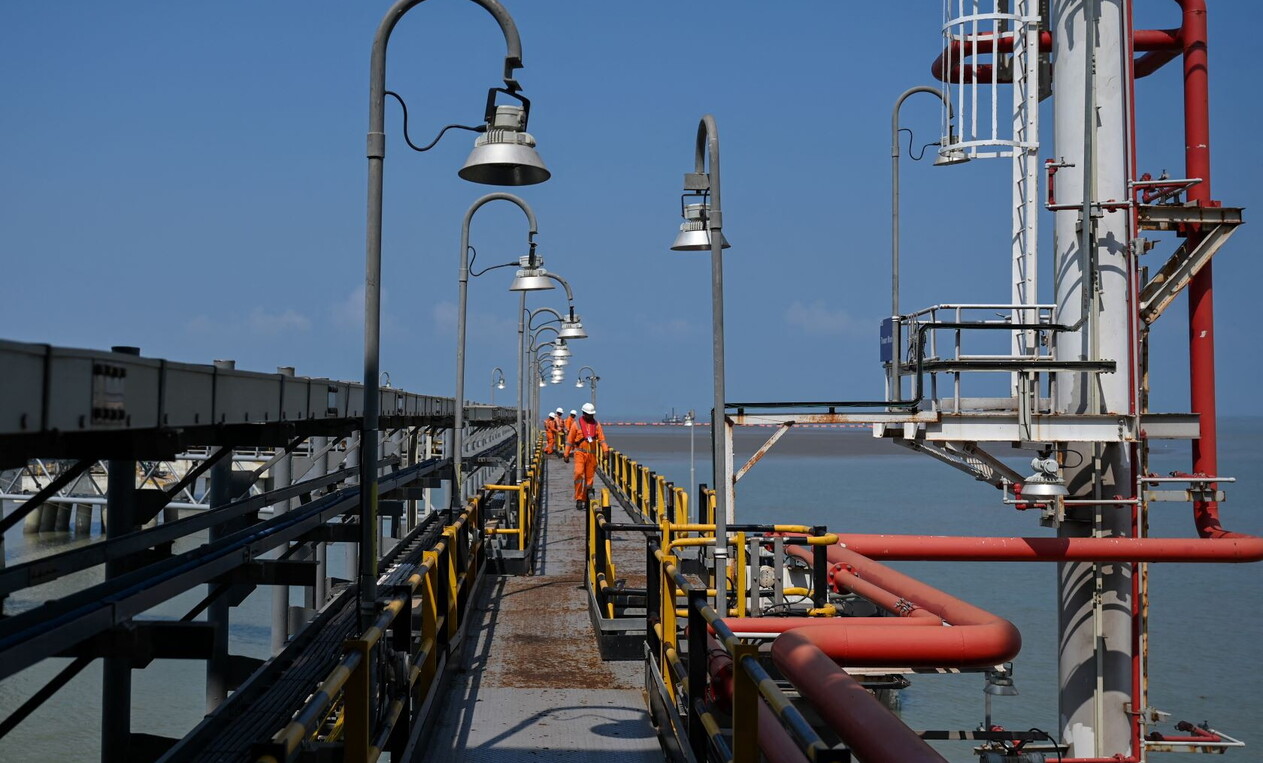
India has followed a similar path. Gas demand in 2010 was just under 65 bcm and has since expanded across fertilisers, industry and city-gas distribution sectors. Domestic supply has not grown sufficiently quickly to meet rising consumption, and India now imports around 35 bcm of natural gas.
On average, the share of natural gas in the overall energy mix is around 5 percent in India and 20 percent in Southeast Asia (although in the latter the share varies from as little as 0 percent in Cambodia and Lao PDR to 61 percent in Brunei Darussalam).
In Southeast Asia, the 30 percent increase in demand to 2035 in the STEPS occurs even as production drops by 15 percent. Its LNG imports therefore increase by around 100 bcm by 2035.
South-East Asia remains one of the fastest-growing regions for industrial production until 2035
In India, the 85 percent growth in natural gas demand to 2035 is largely met by LNG imports, which almost triple from 35 bcm in 2024 to over 100 bcm in 2035. A critical variable affecting the scale of demand growth in India and Southeast Asia is price. In the STEPS, the weighted average gas import price in emerging markets and developing economies in Asia to be around USD 7.5 per million British thermal units (MBtu) in the 2030-2035 period, roughly 40 percent lower than today’s levels. Demand growth could be larger at lower prices.
LNG market balances in the IEA scenarios
Since 2015, consumption of LNG globally has increased twice as fast as that of natural gas, and LNG overtook large-scale pipelines in 2023 as the predominant way of trading gas over long distances. The period from 2025 to 2030 is set to see an unprecedented 300 bcm of new LNG export capacity come online (this translates into a 265 bcm increase in available LNG capacity by 2030 after taking into maintenance, unplanned outages and retirements).
In the STEPS, global LNG demand increases by 200 bcm between 2024 and 2030, a figure below the change in available LNG export capacity. Significant downward pressure on LNG prices would be needed to bring them close to short-run marginal costs, leading to the 160 bcm increase in LNG imports by India and Southeast Asia.
In the CPS, slower transitions in China and Europe increase demand in these markets for gas, meaning that all the new LNG supply finds a market; global gas prices still decline in the near term, but balance at higher levels than in the STEPS. As a result, growth in LNG imports to India and Southeast Asia is slightly more moderate (130 bcm in aggregate to 2035).
In the NZE scenario, a concerted focus on emissions reductions globally through deploying low-emissions sources of electricity generation, electrification, and boosting the efficiency of end-uses leads to an earlier peak and decline in natural gas and LNG demand (although natural gas remains an important part of the global energy system even in 2050).
In all scenarios, a downside risk to the uptake of natural gas and LNG is a failure by industry to reduce methane leaks.
Can coal-to-gas switching by economies in Asia absorb the wave of new LNG in the STEPS?
A central argument made by those that maintain the coming wave of LNG supply can be fully absorbed is that cheap gas could displace coal, especially in emerging markets and developing economies in Asia. The potential is indeed significant: global LNG supply today is equivalent to just eight weeks of coal use in China and India alone.
However, several factors limit this potential from being fully realized. For example, the role of coal in power generation is often shielded from market competition, with coal-fired plants operating in regulated markets or under long-term contracts guaranteeing minimum output. What’s more, many industrial facilities and coal plants rely on cheap domestic coal, meaning the scope for switching using LNG is limited to plants using imported coal. There are also infrastructure and locational constraints, such as the capacity of electricity or gas grids to support near-term switching.
Total energy demand in South-East Asia has increased by 40% since 2015
Still, the IEA estimates that nearly 400 bcm of coal-to-gas switching potential exists in the power and industry sectors in emerging markets and developing economies in Asia. If delivered LNG prices were to fall to USD 5/MBtu, this would unlock an additional 100 bcm of short-term coal-to-gas switching beyond what is projected in STEPS. However, the long-run marginal cost of global LNG supply is well above USD 5/MBtu, and a market with prices at this level would not be balanced and could lead to price corrections later on.
Infrastructure bottlenecks
The projected growth in LNG demand is contingent upon the timely development of infrastructure. Specific constraints could hamper the uptake of LNG in both Southeast Asia and India. In Southeast Asia, several regasification projects remain in the planning stages, creating potential delays in the region’s ability to absorb imported volumes. In India, downstream infrastructure is currently insufficient to fully utilize some of its LNG terminals. Expanding the city-gas distribution sector and industrial connectivity is a prerequisite for realizing the projected demand growth.
Energy security and import dependence
In the STEPS, more than 75 percent of total global LNG exports in 2035 will flow to Asia, up from less than 70 percent in 2024. Around 65 percent of the growth in gas trade to 2035 is driven by exports from the United States and the Middle East destined for Asia.
The shift toward high import dependence presents a complex energy security landscape. Southeast Asia is set to become a net importer of natural gas over the next decade, and oil import dependency is also set to continue to increase. For India and Southeast Asia, high levels of import dependence can act as a double-edged sword: it exposes them to vulnerabilities from global price volatility and supply chain disruptions, but it can also spur development of renewable and nuclear energy, diversify sources of supply, and improve energy efficiency. Still, abundant LNG supply can offer these countries significant optionality for security of supply reasons, and may help them to manage periods of system stress, even though economics of LNG make it difficult to penetrate these markets as a baseload fuel in the long run.
Wrap-up
India and Southeast Asia are undergoing decisive changes, moving from periods of self-sufficiency or moderate imports to central roles in the global LNG trade. As these countries manage rising import dependency, the importance of robust energy security strategies increases.
Diversification remains essential
Safeguarding energy futures involves aligning strategies with the “three golden rules” of energy security articulated by the IEA at the Summit on the Future of Energy Security in London in April 2025: diversification, predictability and cooperation. Diversification is essential not only for LNG suppliers but also for the energy mix itself, expanding renewables and nuclear to mitigate reliance on imported fuels. Predictability is required to overcome infrastructure bottlenecks; investments in regasification and downstream distribution are more effective when proactive rather than reactive to avoid stifling demand and locking in untenable costs at the same time. And finally, international cooperation will be critical to navigating a fragmented geopolitical landscape, ensuring that the further integration of these regions into global markets enhances, rather than compromises, their economic resilience.